

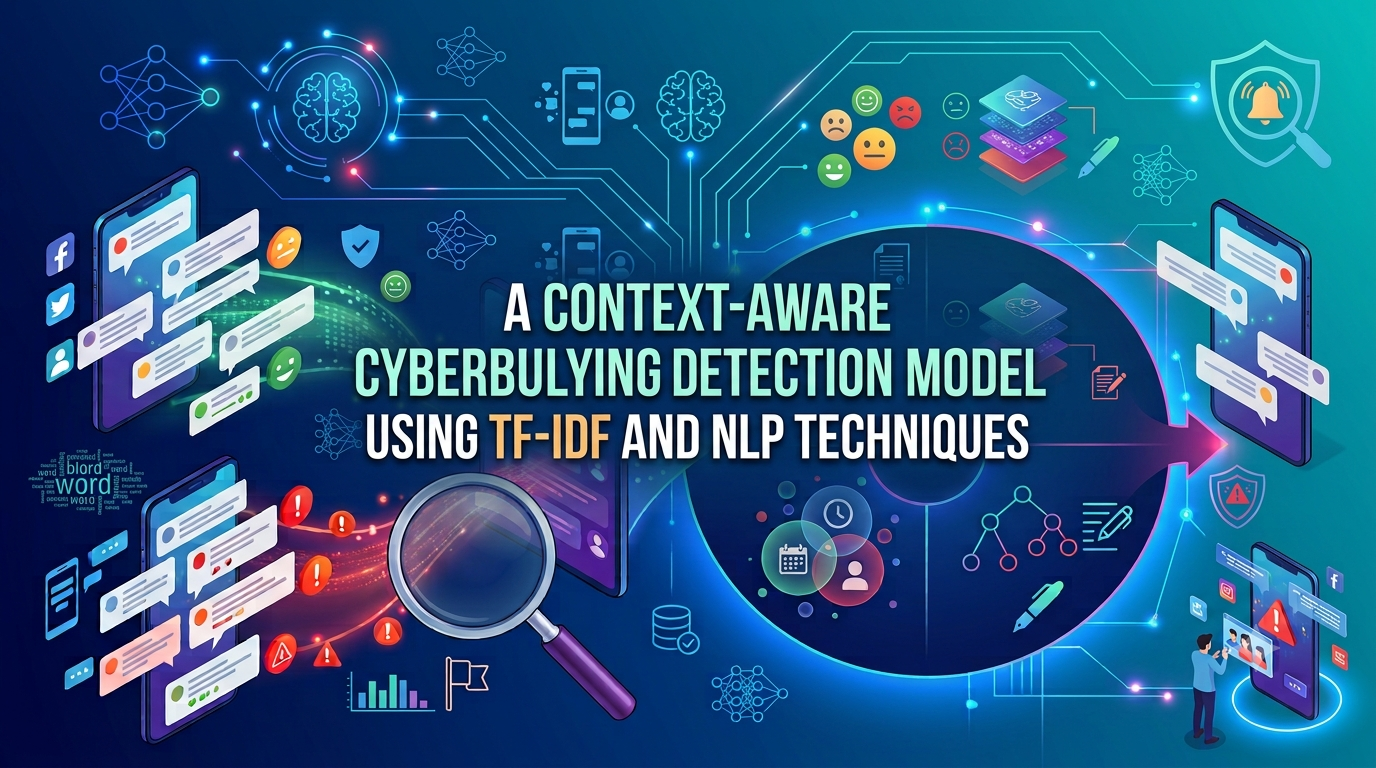
A Context-Aware Cyberbullying Detection Model Using TF-IDF and NLP Techniques
Cyberbullying has become a serious problem on social media platforms, causing emotional and psychological harm to individuals. Manual monitoring of online content is time-consum...
$ 99.00
$ 198.00
Save 50%
Quality Guaranteed
Reviewed project files and clear structure.
24/7 Support
Reach us anytime for setup and usage help.
Instant Access
Download your files right after checkout.
Source Included
Code, assets, and project-ready materials included.
About This Product
A Context-Aware Cyberbullying Detection Model Using TF-IDF and NLP Techniques
Description:
Cyberbullying has become a serious problem on social media platforms, causing emotional and psychological harm to individuals. Manual monitoring of online content is time-consuming and inefficient due to the large volume of user-generated text. This project proposes a context-aware cyberbullying detection system that automatically identifies harmful and abusive content using Natural Language Processing (NLP) techniques.
The system uses TF-IDF (Term Frequency–Inverse Document Frequency) to convert textual data into numerical feature representations that capture the importance of words in a given context. These features are then classified using supervised machine learning algorithms to determine whether a given text contains cyberbullying behavior or not.
A user-friendly web-based application is developed using the Flask framework, allowing users to securely log in, input text, and receive real-time predictions along with confidence scores. The proposed model aims to improve online safety by providing an efficient, accurate, and scalable solution for cyberbullying detection.
Input : Social media comments
Output : Cyberbullying category
Tags :
#CyberbullyingDetection, #NaturalLanguageProcessing, #NLP, #TFIDF, #MachineLearning, #SupervisedLearning, #TextClassification, #HateSpeechDetection, #OnlineSafety, #ContentModeration, #FlaskApp, #PythonProject, #WebBasedML, #SocialMediaAnalytics
References:
1.Dadvar, M., Trieschnigg, D., Ordelman, R., and de Jong, F. (2013). Improving cyberbullying detection with user context. Proceedings of the 35th European Conference on Advances in Information Retrieval (ECIR), Springer.
Yin, D., Xue, Z., Hong, L., Davison, B. D., Kontostathis, A., and Edwards, L. (2009). Detection of harassment on web 2.0. Proceedings of the Content Analysis in the WEB 2.0 Workshop, WWW Conference.
Backend Programming Language
Python
Backend Web Framework
Flask
Frontend Structure
HTML
Frontend Styling
CSS
No reviews available for this product.
Add Your Review
You May Also Like
View All