
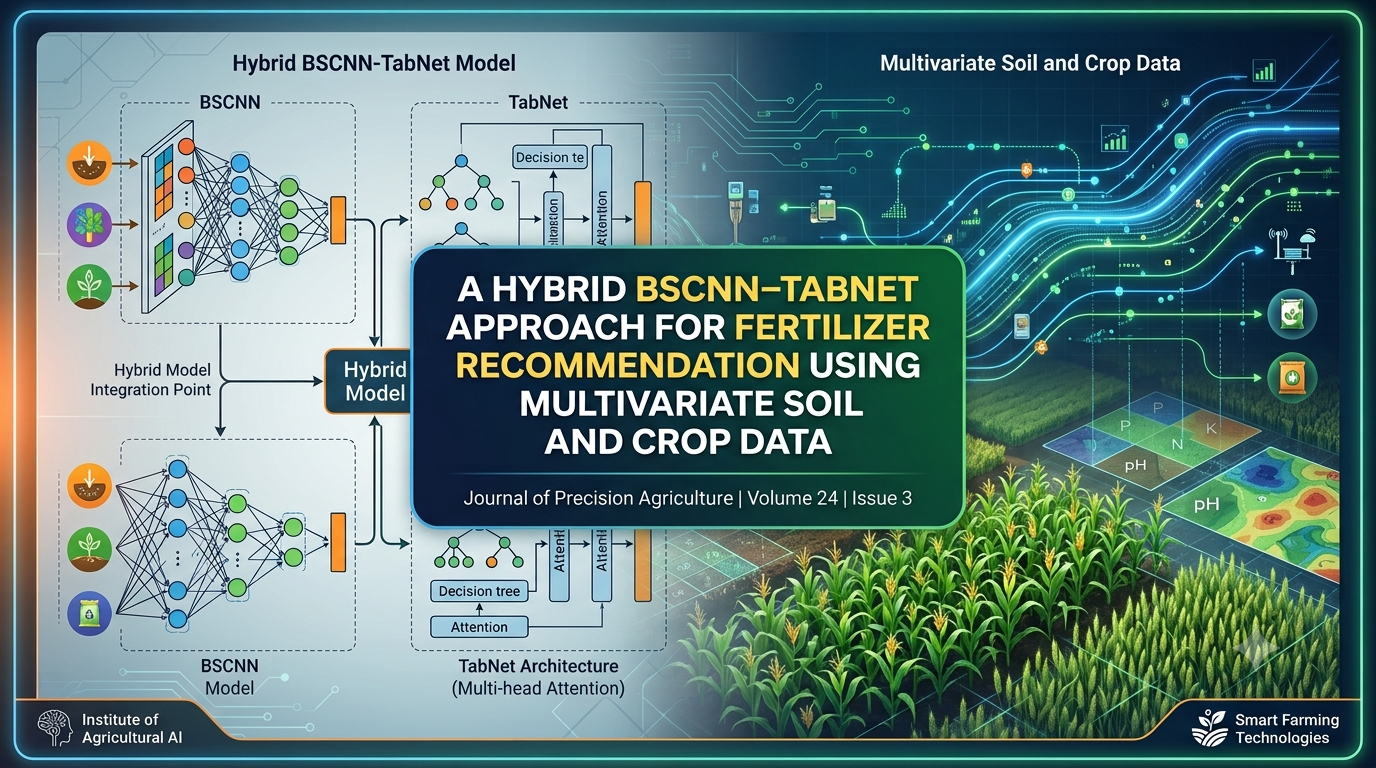
A Hybrid BSCNN–TabNet Approach for Fertilizer Recommendation Using Multivariate Soil and Crop Data
This work proposes a hybrid BSCNN–TabNet based machine learning approach for fertilizer recommendation using multivariate soil, environmental, and crop data. The objective of th...
About This Product
A Hybrid BSCNN–TabNet Approach for Fertilizer Recommendation Using Multivariate Soil and Crop Data
Description:
This work proposes a hybrid BSCNN–TabNet based machine learning approach for fertilizer recommendation using multivariate soil, environmental, and crop data. The objective of the system is to predict a suitable fertilizer by learning the relationship between soil nutrient levels, weather conditions, soil type, and crop type.
The dataset consists of numerical features such as temperature, moisture, rainfall, pH, nitrogen, phosphorous, potassium, and carbon, along with categorical features representing soil type and crop type. These features describe the overall soil condition and growing environment. A BSCNN identity layer is used to stabilize and organize the input features before feeding them into the TabNet model.
TabNet is used as the main prediction model due to its effectiveness on tabular data and its feature attention mechanism. It selectively focuses on the most relevant features during prediction, improving accuracy and interpretability. The final output is a fertilizer recommendation along with a simple usage remark, making the system practical for real-world agricultural decision support.
Input : Soil condition and environmental factors
Output : Fertilizer recommendation
Tags :
#MachineLearning #DeepLearning #AgriculturalInformatics #PrecisionAgriculture #SmartAgriculture #FertilizerRecommendation #SoilHealth #SoilNutrients #CropAdvisory #TabNet #BSCNN #HybridModel #AIinAgriculture #DataAnalytics #PredictiveModeling #DecisionSupportSystem #SustainableFarming #AgriTech #MLModels #FeatureLearning #MultivariateData #SupervisedLearning
References:
1.Deone, J., Afreen, K. R., & Mangrule, R. (2024). Machine Learning Approaches for Crop Prediction and Fertilizer Recommendation based on Soil Nutrients. Journal of Electrical Systems, 20(11s). This study explores the application of various ML methods to improve crop prediction and fertilizer recommendation by analysing soil nutrients and environmental data, highlighting the potential of data-driven agricultural decision-making.
Chandraiah, G., Divya, D. R., Susmitha, G., Kuladeep, G., Bhavana, G., & Reddy, K. G. (2025). ML-Based Soil Analysis for Crop Suggestion and Fertilizer Recommendation. In ICITSM Part I, EAI. This research proposes a machine learning system that uses soil sensor data (e.g., moisture and NPK values) for recommending crops and fertilizers, demonstrating how structured agricultural data can inform precise nutrient and crop choices.
Python
Falsk
HTML
CSS
No reviews available for this product.