
Adaptive EEG Eye State Detection via Fast Kalman Filter & Tree-DCNN with AReXNet Feature Learning
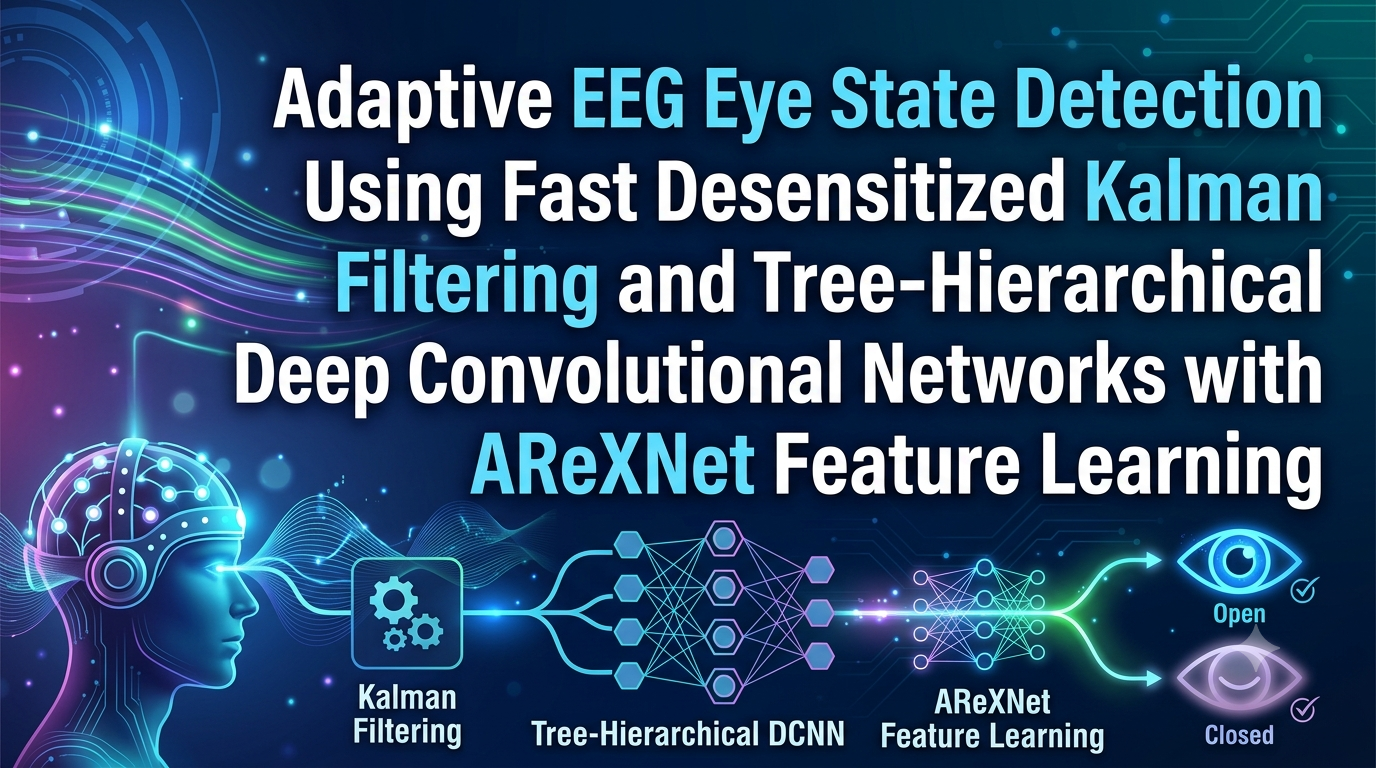
The proposed work titled “Adaptive EEG Eye State Detection Using Fast Desensitized Kalman Filtering and Tree-Hierarchical Deep Convolutional Networks with AReXNet Feature Learni...
About This Product
Adaptive EEG Eye State Detection Using Fast Desensitized Kalman Filtering and Tree-Hierarchical Deep Convolutional Networks with AReXNet Feature Learning
Description:
The proposed work titled “Adaptive EEG Eye State Detection Using Fast Desensitized Kalman Filtering and Tree-Hierarchical Deep Convolutional Networks with AReXNet Feature Learning” focuses on accurately identifying human eye states (open or closed) using electroencephalogram (EEG) signals. Eye state detection plays an important role in applications such as brain–computer interfaces, driver drowsiness monitoring, human–computer interaction, and neurological assessment systems. However, raw EEG signals are highly sensitive to noise, artifacts, and subject variability, which reduces classification reliability. To address this challenge, the proposed system introduces an adaptive preprocessing and deep learning-based classification framework.
In this approach, Fast Desensitized Kalman Filtering (FDKF) is applied during the preprocessing stage to effectively remove noise, suppress artifacts, and stabilize EEG signal fluctuations while preserving important temporal information. This adaptive filtering technique improves signal quality and robustness against uncertainty in EEG measurements. The filtered signals are then fed into a Tree-Hierarchical Deep Convolutional Neural Network (THDCNN), which organizes EEG feature learning in a hierarchical structure to capture both local and global temporal-spatial patterns. Additionally, AReXNet-based feature learning is incorporated to enhance discriminative feature extraction by learning adaptive representations from multi-channel EEG inputs.
Experimental results demonstrate that the proposed framework achieves high accuracy, precision, and robustness in distinguishing between eye-open and eye-closed states. The integration of adaptive Kalman filtering with hierarchical deep convolutional learning significantly improves classification performance compared to conventional CNN and machine learning approaches. Overall, this system provides an efficient and reliable EEG-based eye state detection model suitable for real-time and practical brain-computer interface applications.
Input:
EEG Signal Data (CSV File)
Output:
Eye Open or Eye Closed
Tags:
#EEG, #Eye State Detection, #BCI, #Deep Learning, #Kalman Filter, #THDCNN, #AReXNet, #Neural Networks, #Biomedical AI, #Signal Processing, #Django AI, # Fast Desensitized Kalman Filter (FDKF), # Adaptive Signal Filtering, # Django Deep Learning Deployment, # Noise-Resilient Signal Processing, # AI-Driven Healthcare Systems
Reference:
1. He, X., Liao, L., Zhang, H., Nie, L., Hu, X., & Chua, T.-S. (2017). Neural Collaborative Filtering. Proceedings of the 26th International Conference on World Wide Web (WWW), 173–182. DOI: 10.1145/3038912.3052569
2. Klados, M. A., Papadelis, C., Braun, C., & Bamidis, P. D. (2011). REG-ICA: A Hybrid Method Combining Blind Source Separation and Regression Techniques for the Rejection of Ocular Artifacts. Biomedical Signal Processing and Control, 6(3), 291–300. DOI: 10.1016/j.bspc.2011.02.001
3. Lawhern, V. J., Solon, A. J., Waytowich, N. R., Gordon, S. M., Hung, C. P., & Lance, B. J. (2018). EEGNet: A Compact Convolutional Neural Network for EEG-Based Brain–Computer Interfaces. Journal of Neural Engineering, 15(5). DOI: 10.1088/1741-2552/aace8c
Python
Django
HTML
CSS
No reviews available for this product.