
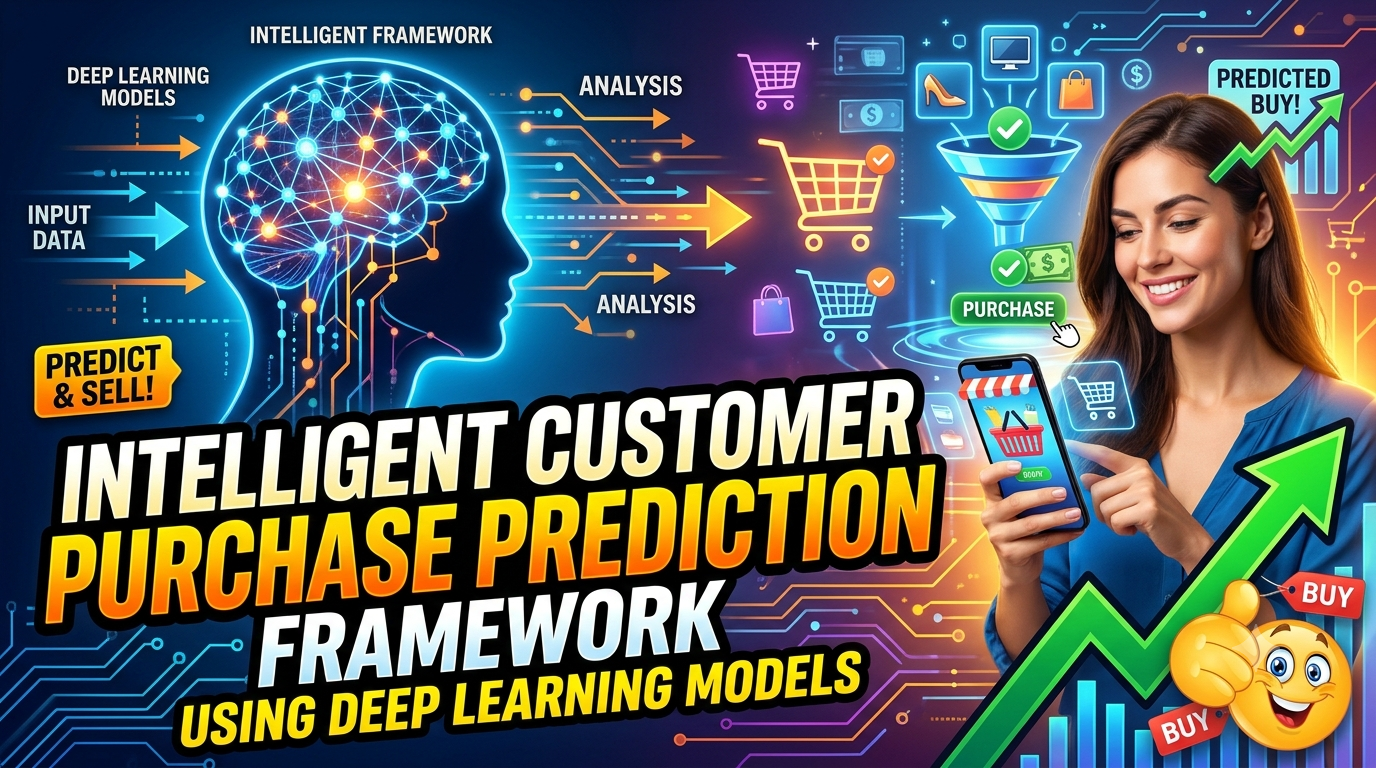
An Intelligent Customer Purchase Prediction Framework Using Deep Learning Models
In modern e-commerce and retail, understanding whether a customer is likely to complete a purchase is central to marketing efficiency, inventory planning, and revenue growth...
About This Product
An Intelligent Customer Purchase Prediction Framework Using Deep Learning Models
1. Introduction
In modern e-commerce and retail, understanding whether a customer is likely to complete a purchase is central to marketing efficiency, inventory planning, and revenue growth. Businesses collect large volumes of customer information, including demographics, income, browsing behavior, purchase history, loyalty membership, and exposure to discounts. Traditionally, this information is analyzed through manual segmentation and rule-based heuristics, which are slow to adapt, difficult to scale, and unable to capture complex non-linear relationships between customer attributes and buying decisions.Recent advances in machine learning and deep learning have made data-driven purchase prediction practical. Artificial Neural Networks (ANNs) are well suited to tabular customer data because their stacked hidden layers can learn non-linear interactions among features such as age, annual income, number of previous purchases, website time, and discount usage. However, raw customer attributes differ widely in scale and type, so a reliable preprocessing stage involving feature encoding and standardization is required to ensure stable training and consistent predictions.To move beyond an offline experiment, this work integrates the trained ANN and the pre-trained feature scaler into an interactive Django web application. The system presents a customer input form, validates the entered values, converts them into a NumPy array, scales them with the saved scaler, and passes them to the trained network. The predicted purchase probability is compared against a threshold of 0.5 to decide between Will Purchase and Will Not Purchase, and a confidence percentage is displayed alongside the result, giving business users a simple and practical decision-support tool.
2. Problem Statement
Conventional approaches to predicting customer purchase behavior are characterized by:
•Heavy reliance on manual analysis and fixed business rules that cannot capture non-linear relationships among customer attributes
•Poor scalability as the volume and variety of customer data grow
•Inconsistent feature scales and mixed data types (numerical and categorical) that reduce model reliability when left unprocessed
•Lack of an accessible interface that lets non-technical users enter customer details and obtain an instant, interpretable prediction
There is a clear need for an automated, end-to-end system that preprocesses customer data, learns purchase patterns using a deep learning model, evaluates its performance with standard metrics, and delivers the predicted outcome with a confidence score through an easy-to-use web platform.
3. Input
•Customer purchase behavior dataset containing demographic, financial, and behavioral attributes
•Input features: Age, Gender, Annual Income, Number of Purchases, Product Category, Website Time, Loyalty Program, and Discounts
•Target label: purchase status (Will Purchase / Will Not Purchase)
•Pre-trained feature scaler and trained ANN model loaded when the application starts
•Real-time user input: customer details entered through the Django web form, validated before processing
4. Output
Model training and evaluation artifacts:
•Accuracy vs. Epochs curve
•Loss vs. Epochs curve
•Confusion Matrix
•ROC Curve
•Performance Metrics (Accuracy, Error Rate, Precision, Recall, F1-Score, Specificity, ROC-AUC)
Saved model artifacts and web application output:
•Saved trained ANN model file and pre-trained scaler file
•Validation error messages for incomplete or invalid form entries
•Real-time prediction: predicted purchase probability and final decision (Will Purchase or Will Not Purchase) using a 0.5 threshold
•Confidence percentage displayed together with the prediction result
5. Novelty
•An ANN-based purchase prediction framework that learns non-linear relationships between demographic, financial, and behavioral customer attributes
•A consistent preprocessing pipeline in which a pre-trained scaler, saved after training, is reused at prediction time so that web inputs are transformed exactly like the training data
•A probability-based decision rule with a 0.5 threshold, accompanied by a confidence percentage that makes each prediction easier to interpret
•Complete end-to-end integration of the deep learning pipeline with a Django web application that includes form validation and an error-correction loop
6. Contribution
Developed a complete machine learning pipeline:
•Dataset loading, exploratory analysis, and preprocessing (encoding of categorical features and feature scaling)
•Design, training, and validation of the ANN model with Accuracy vs. Epochs and Loss vs. Epochs convergence tracking
•Performance evaluation using Confusion Matrix, ROC Curve, Accuracy, Error Rate, Precision, Recall, F1-Score, and Specificity
•Model and scaler persistence for reuse during deployment
Built a user-friendly Django web interface incorporating:
•A customer input form covering Age, Gender, Annual Income, Number of Purchases, Product Category, Website Time, Loyalty Program, and Discounts
•Input validation with clear error display and re-entry of the form when data is invalid
•Real-time prediction pipeline: conversion to a NumPy array, scaling, ANN inference, and thresholding of the purchase probability
•Display of the prediction result together with its confidence percentage
7. Conclusion
The proposed framework automates customer purchase prediction by combining systematic data preprocessing with an Artificial Neural Network and a Django-based web interface. Training stability is verified through Accuracy vs. Epochs and Loss vs. Epochs plots, and model quality is assessed with the confusion matrix, ROC curve, and standard classification metrics. By reusing the pre-trained scaler at prediction time and reporting both the decision and a confidence percentage, the system delivers consistent and interpretable results. The integrated web application allows business users to enter customer details and obtain an instant prediction, supporting targeted marketing, better customer engagement, and more informed sales decisions.
8. References
[1] I. Goodfellow, Y. Bengio, and A. Courville, Deep Learning. Cambridge, MA, USA: MIT Press, 2016.
[2] Y. LeCun, Y. Bengio, and G. Hinton, "Deep learning," Nature, vol. 521, no. 7553, pp. 436–444, 2015.
[3] D. E. Rumelhart, G. E. Hinton, and R. J. Williams, "Learning representations by back-propagating errors," Nature, vol. 323, pp. 533–536, 1986.
[4] D. P. Kingma and J. Ba, "Adam: A method for stochastic optimization," in Proc. International Conference on Learning Representations (ICLR), 2015.
[5] F. Pedregosa et al., "Scikit-learn: Machine learning in Python," Journal of Machine Learning Research, vol. 12, pp. 2825–2830, 2011.
Python
Django
HTML
CSS
No reviews available for this product.