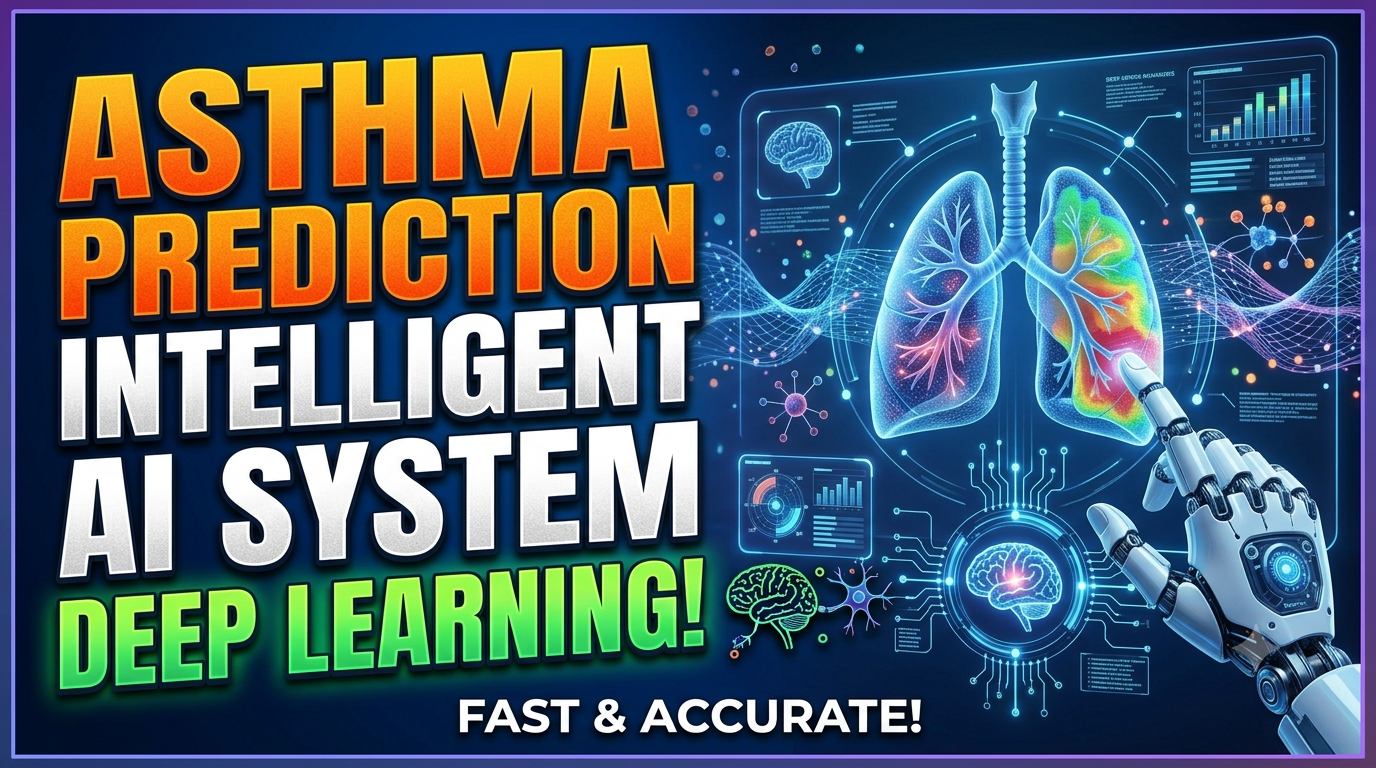
An Intelligent Deep Learning-Based System for Accurate Asthma Disease Prediction
Asthma is a chronic respiratory disease characterized by airway inflammation, wheezing, shortness of breath, and chest tightness, affecting millions of people worldwide. It...
$ 79.00
Quality Guaranteed
Reviewed project files and clear structure.
24/7 Support
Reach us anytime for setup and usage help.
Instant Access
Download your files right after checkout.
Source Included
Code, assets, and project-ready materials included.
About This Product
Intelligent Asthma Disease Prediction Using a Batch-Normalized Deep Neural Network with Feature Scaling and an Integrated Django Web Framework
1. Introduction
Asthma is a chronic respiratory disease characterized by airway inflammation, wheezing, shortness of breath, and chest tightness, affecting millions of people worldwide. Its onset and severity depend on many interacting factors, including demographics, lifestyle, environmental exposure, allergy history, lung function, and symptoms. Traditional diagnosis relies on clinical examination and spirometry interpretation, which can be time-consuming and subjective. These challenges highlight the need for automated, data-driven systems capable of early and consistent asthma risk assessment.Recent advances in machine learning and deep learning have enabled accurate analysis of structured clinical data. Deep Neural Networks (DNNs) can learn complex non-linear relationships between patient attributes and disease outcomes. However, raw clinical records contain features with widely different numerical ranges, which can destabilize training. To address these limitations, all input features are standardized using a StandardScaler. A fully connected DNN with hidden layers of 128, 64, and 32 neurons, ReLU activation, batch normalization, and dropout regularization is then trained for binary classification, with a sigmoid output layer producing the probability of asthma. The model is optimized using the Adam optimizer and binary cross-entropy loss, and training convergence is monitored through Accuracy vs. Epochs and Loss vs. Epochs curves.o bridge the gap between model development and practical use, the trained workflow is integrated into an interactive, user-friendly Django web application. The system provides a structured input form covering demographic, lifestyle, environmental, medical history, clinical, and symptom details, applies the same feature scaling used during training, and returns the diagnosis status, risk level, and probability. This delivers a practical tool for early asthma screening and clinical decision support.
2. Problem Statement
Manual diagnosis and risk assessment of asthma are characterized by:
- Time-consuming evaluation and dependence on clinical expertise
- Subjective interpretation of symptoms and spirometry readings
- Difficulty combining many demographic, environmental, and clinical factors into one assessment
- Lack of an accessible interface for obtaining instant, data-driven asthma risk predictions from trained models
There is a critical need for an automated, reliable end-to-end system that scales patient data consistently, accurately predicts asthma risk using a deep neural network, tracks training progression using convergence curves, and delivers the risk level and probability in real time through an accessible web platform.
3. Input
- Asthma patient dataset (clinical records with diagnosis labels)
- Demographic details: Age, Gender, Ethnicity, Education Level
- Lifestyle and environmental factors: BMI, Smoking, Physical Activity, Diet, Sleep, Pollution, Pollen, Dust
- Medical history, lung function (FEV1, FVC), and symptom indicators
- Real-time user input: Patient details submitted through the Django web form
4. Output
Model training & validation evaluation artifacts:
- Accuracy vs. Epochs curve
- Loss vs. Epochs curve
- Confusion Matrix
- ROC Curve
- Performance Metrics (Accuracy, Error Rate, Precision, Recall, F1-Score)
Saved model artifacts and web application output:
- Saved model file (.h5) and fitted scaler object (.pkl)
- Real-time classification results: Diagnosis status (Yes/No), risk level, and probability
- Interactive web display: Result page showing diagnosis, LOW/HIGH risk label, and probability with a back option
5. Novelty
- Integration of StandardScaler preprocessing with a deep neural network to handle high-dimensional clinical, lifestyle, and environmental patient attributes reliably.
- Implementation of a DNN with batch normalization and dropout regularization (128, 64, and 32 neurons) to stabilize training and reduce overfitting.
- Dynamic model performance monitoring through Accuracy vs. Epochs and Loss vs. Epochs convergence plotting.
- Complete end-to-end fusion combining a deep learning training pipeline with a lightweight Django web application that supports real-time risk prediction through a sectioned patient input form.
6. Contribution
Developed a complete machine learning pipeline:
- Dataset loading, reading, exploratory analysis, and preprocessing
- Feature scaling using StandardScaler
- DNN model training, validation, and convergence tracking (Accuracy vs. Epochs, Loss vs. Epochs)
- Performance evaluation metrics (Confusion Matrix, ROC Curve, Accuracy, Error Rate, Precision, Recall, F1-Score)
- Model persistence (.h5 and .pkl)
Built a sectioned, user-friendly Django web interface incorporating:
- Sectioned patient input form with demographic, lifestyle, and clinical fields
- Safe input conversion to prevent server errors from missing values
- Instant result page showing diagnosis status, risk level, and probability with color-coded risk indication for easy interpretation
7. Conclusion
The proposed system successfully automates asthma risk prediction by combining feature scaling with a Batch-Normalized Deep Neural Network. Training stability and optimization were verified through Accuracy vs. Epochs and Loss vs. Epochs convergence plots. The model achieves reliable classification performance, validated through confusion matrices, ROC curves, and standard performance metrics. Furthermore, seamless integration with a Django-based web application ensures practical, real-world utility, enabling users to enter patient details and instantly obtain the asthma diagnosis status, risk level, and probability through a simple interface.
8. References
[1] Y. LeCun, Y. Bengio, and G. Hinton, "Deep Learning," Nature, vol. 521, no. 7553, pp. 436–444, 2015.
[2] S. Ioffe and C. Szegedy, "Batch Normalization: Accelerating Deep Network Training by Reducing Internal Covariate Shift," in Proceedings of the International Conference on Machine Learning (ICML), pp. 448–456, 2015.
[3] N. Srivastava, G. Hinton, A. Krizhevsky, I. Sutskever, and R. Salakhutdinov, "Dropout: A Simple Way to Prevent Neural Networks from Overfitting," Journal of Machine Learning Research, vol. 15, pp. 1929–1958, 2014.
[4] D. P. Kingma and J. Ba, "Adam: A Method for Stochastic Optimization," in Proceedings of the International Conference on Learning Representations (ICLR), 2015.
Backend Programming Language
Python
Backend Web Framework
Django
Frontend Structure
HTML
Frontend Styling
CSS
No reviews available for this product.