
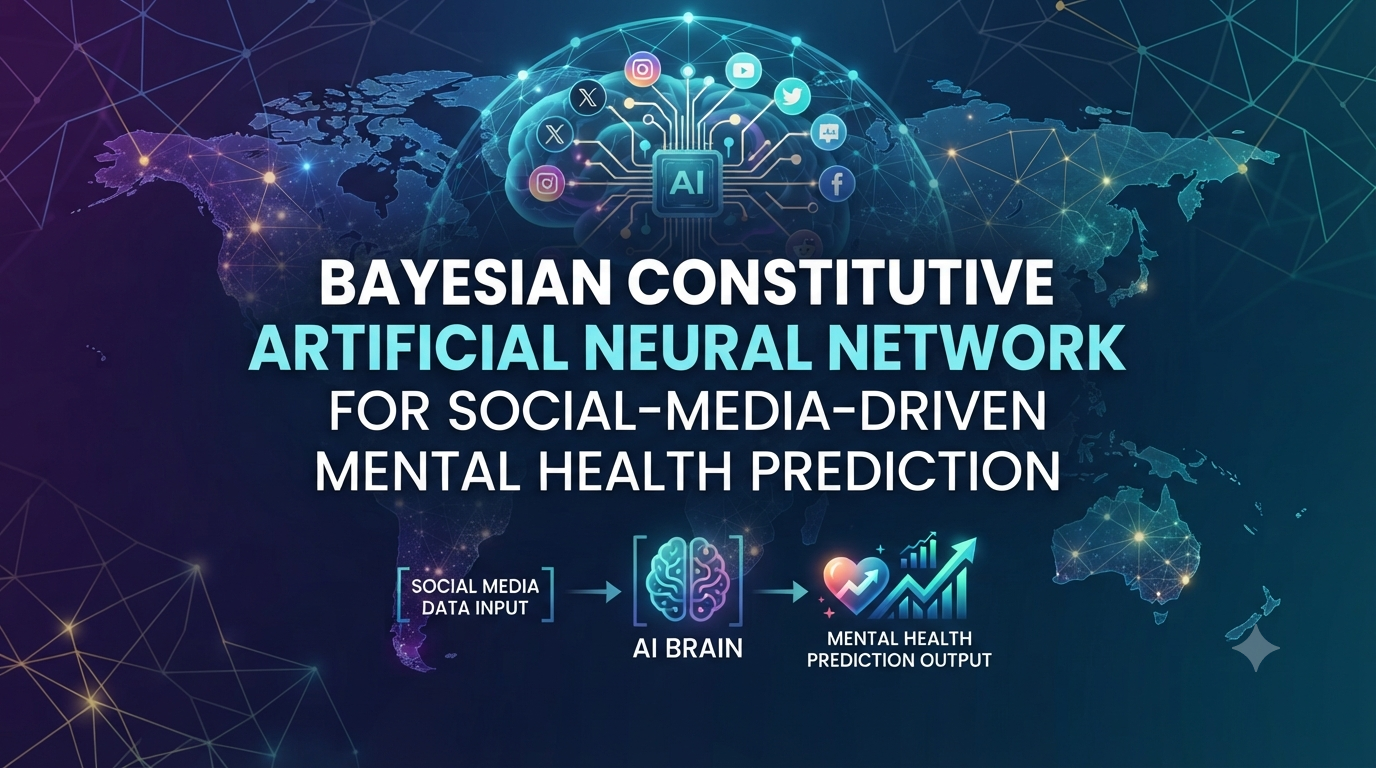
Bayesian Constitutive Artificial Neural Network for Social-Media-Driven Mental Health Prediction
B-CANN: Bayesian Constitutive Artificial Neural Network for Social-Media-Driven Mental Health Prediction is an advanced deep learning framework engineered to infer mental health...
About This Product
Bayesian Constitutive Artificial Neural Network for Social-Media-Driven Mental Health Prediction
Description:
B-CANN: Bayesian Constitutive Artificial Neural Network for Social-Media-Driven Mental Health Prediction is an advanced deep learning framework engineered to infer mental health states from large-scale social media data. By integrating Bayesian reasoning with constitutive neural modeling, B-CANN quantifies uncertainty, enhances interpretability, and adapts dynamically to heterogeneous linguistic and behavioral signals. This architecture captures subtle emotional, semantic, and contextual patterns in user-generated content, enabling accurate and reliable mental health predictions. The model is designed to overcome limitations of traditional text-classification networks by incorporating probabilistic inference and robust feature integration, supporting early detection, monitoring, and decision-making in digital mental health applications.
Input:
Textual content,behavior (likes/shares/comments)
Output:
Predicted Mental Health Category (e.g., Normal, Depression, Anxiety, Stress, Suicidal Ideation, Bipolar Indicators, Personality-Related Conditions)
Tags:
#BCANN #BayesianNeuralNetwork #ConstitutiveModeling #MentalHealthPrediction #AIDigitalHealth #SocialMediaAnalytics #DeepLearning #UncertaintyQuantification #ProbabilisticAI #NLP #SentimentAnalysis #PsycholinguisticModeling #BehavioralAnalytics #AIinHealthcare #MentalHealthAI #MachineLearning #PredictiveModels #ExplainableAI #TechInnovation #IntelligentSystems #DigitalPsychology
References:
1. Srividya, M., Mohanavalli, S. and Bhalaji, N., 2018. Behavioral modeling for mental health using machine learning algorithms. Journal of medical systems, 42(5), p.88.
2. Graham, S., Depp, C., Lee, E.E., Nebeker, C., Tu, X., Kim, H.C. and Jeste, D.V., 2019. Artificial intelligence for mental health and mental illnesses: an overview. Current psychiatry reports, 21(11), p.116.
3. Barros, J., Morales, S., García, A., Echávarri, O., Fischman, R., Szmulewicz, M., Moya, C., Núñez, C. and Tomicic, A., 2020. Recognizing states of psychological vulnerability to suicidal behavior: a Bayesian network of artificial intelligence applied to a clinical sample. BMC psychiatry, 20(1), p.138.
Python
Django
HTML
CSS
No reviews available for this product.