
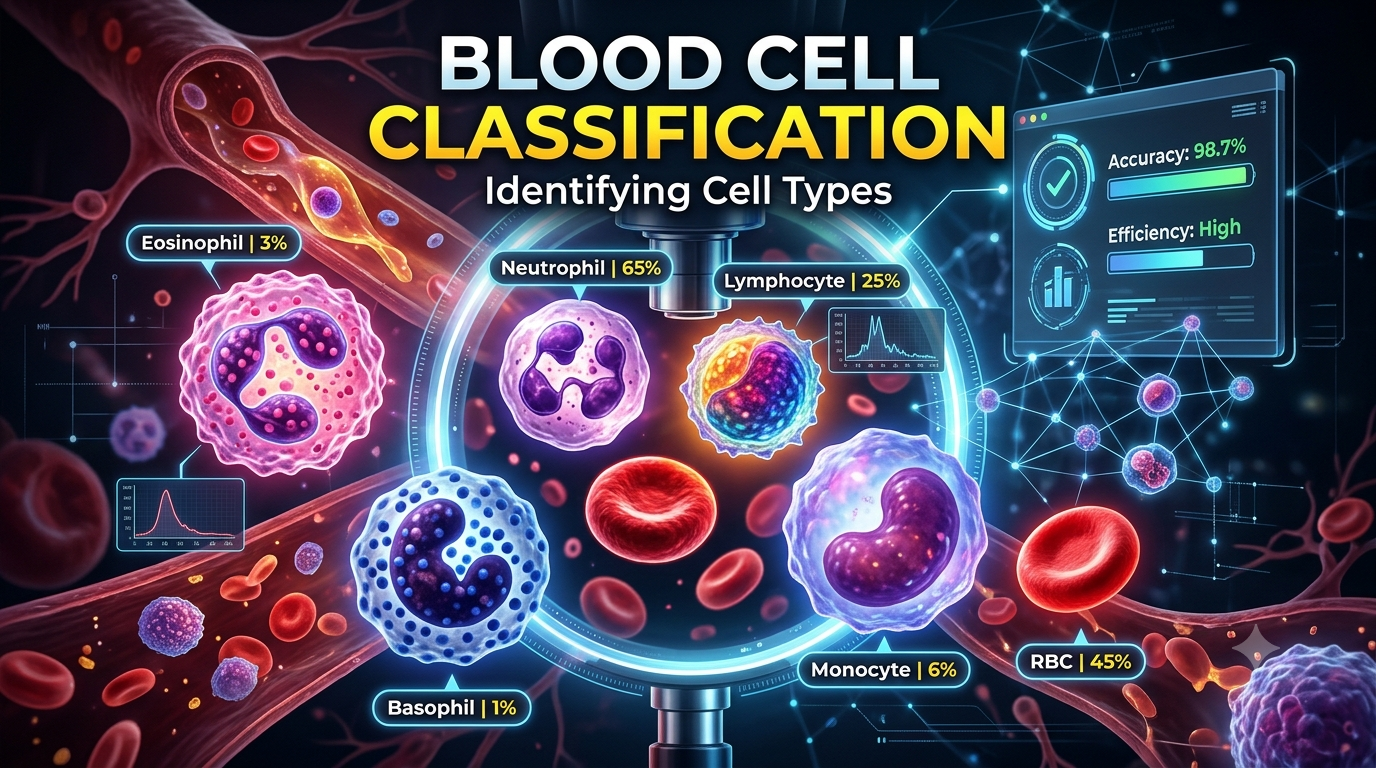
Blood Cell Classification
Acute Lymphoblastic Leukemia (ALL) is an aggressive blood cancer in which immature white blood cells multiply uncontrollably in the bone marrow and blood. Early and accurate ide...
$ 79.00
Quality Guaranteed
Reviewed project files and clear structure.
24/7 Support
Reach us anytime for setup and usage help.
Instant Access
Download your files right after checkout.
Source Included
Code, assets, and project-ready materials included.
About This Product
Blood Cell Classification
1. Introduction
Acute Lymphoblastic Leukemia (ALL) is an aggressive blood cancer in which immature white blood cells multiply uncontrollably in the bone marrow and blood. Early and accurate identification of the disease and its subtype is crucial for timely treatment planning.Traditionally, diagnosis relies on a hematologist examining peripheral blood smear (PBS) images under a microscope, which is time-consuming, subjective, and dependent on the availability of trained specialists.These limitations underscore the need for automated diagnostic support systems that can assist clinicians and researchers in making rapid and consistent decisions.Recent advancements in deep learning, particularly convolutional neural networks (CNNs), have transformed medical image analysis by learning discriminative visual features directly from raw images. However, benign lymphoid cells (hematogones) and early-stage malignant cells look very similar, and the three malignant subtypes differ only in subtle morphological details, making the task challenging.
In this work, an intelligent framework is proposed for the classification of blood cell images into four categories: Benign, Malignant Early Pre-B, Malignant Pre-B, and Malignant Pro-B.The methodology encompasses image collection and preprocessing, resizing and normalization of each image, and training of a CNN-based classifier that outputs a probability for each of the four classes.Furthermore, the trained model is integrated into a web-based application using Django, enabling real-time image upload and prediction. This end-to-end system provides a user-friendly interface for automated screening support, making it practical for educational and research settings.The proposed approach aims to improve diagnostic efficiency and reduce inter-observer variability, contributing to early detection of leukemia subtypes.
2. Problem Statement
Manual examination and classification of blood cells present several critical challenges in diagnostic workflows:
Time & Labor Intensive: Traditional assessment requires a specialist to inspect many microscope fields per patient, consuming substantial time and effort.
Subjectivity & Error: Interpretations are prone to human error and inter-observer variability, especially when distinguishing benign hematogones from early-stage malignant cells.
Visual Similarity Between Classes: Benign, Early Pre-B, Pre-B, and Pro-B cells share overlapping morphology, which makes subtype discrimination difficult even for experienced observers.
Expert Shortage: Access to qualified hematologists and pathologists is limited, particularly in under-resourced regions.
There is an urgent need for an automated, reliable system that can process blood smear images and classify them into Benign, Early Pre-B, Pre-B, and Pro-B categories with high precision and minimal delay.
3. Input & Dataset Specifications
Dataset Volume: Peripheral blood smear image dataset (Kaggle, Aria et al.) containing 3,256 images collected from 89 patients suspected of ALL, comprising 504 Benign, 985 Early Pre-B, 963 Pre-B, and 804 Pro-B samples.
Supported File Formats: Standard visual formats including .jpg, .png, and .jpeg.
Target Classification Classes: Four-class target consisting of Benign, Malignant Early Pre-B, Malignant Pre-B, and Malignant Pro-B.
Image Preprocessing: Each image is resized to 224 × 224 pixels and pixel values are normalized to the range 0–1 before being passed to the model.
User Input Mechanism: Interactive user submission via blood cell image upload on the Django web application dashboard.
4. Expected System Output
The system is designed to provide clear, actionable output upon processing an uploaded sample:
Predicted Class Label: Automated classification result designated as Benign, Malignant Early Pre-B, Malignant Pre-B, or Malignant Pro-B.
Confidence Score: Model output probability for the predicted class, expressed as a percentage.
Visual Result Dashboard: Interactive display showing the original uploaded image alongside the predicted label and confidence metric.
5. Novelty
Multi-Class Subtype Classification: Goes beyond simple benign-versus-malignant detection by distinguishing three ALL subtypes (Early Pre-B, Pre-B, Pro-B) from benign hematogones.
CNN-Based Feature Learning: A deep convolutional neural network learns discriminative morphological features directly from peripheral blood smear images, without manual feature engineering.
Confidence-Aware Prediction: Every prediction is accompanied by a probability score, allowing users to judge the reliability of the result.
End-to-End Application Deployment: Seamless combination of deep-learning classification and a full-stack Django web interface for live image upload and instant prediction.
6. Research Contribution
The proposed work establishes a complete, modular end-to-end framework encompassing the following key milestones:
Preprocessing Pipeline: Design and implementation of automated image resizing and normalization routines.
Model Training: Training of a CNN-based classifier on labeled blood smear images for four-class prediction.
Evaluation & Deployment: Systematic performance evaluation and web-based application deployment for live inference.
Multi-Class Classification: Distinction of blood cell samples into benign and three malignant ALL subtype categories.
Comprehensive Metrics: Evaluation across standardized performance metrics including accuracy, precision, recall, F1-score, and confusion matrix.
User-Centric Web Application: A Django web interface providing seamless image uploads, live diagnostic feedback, and structured prediction displays.
7. Conclusion
The proposed system applies a convolutional neural network to automate the classification of blood cell images into Benign, Early Pre-B, Pre-B, and Pro-B categories.The framework is designed to reduce reliance on manual microscopic examination and to provide fast, consistent, and reproducible screening support.Integration with a Django-based web application makes the platform directly accessible to users for immediate image upload and inference.The system is intended as a decision-support tool for research and education, not as a replacement for clinical diagnosis. Claims regarding achieved diagnostic accuracy and operational deployment readiness should be reported following verification through comprehensive experimental evaluation.
8. References
[1] M. Aria, M.
Ghaderzadeh, D. Bashash, H. Abolghasemi, F. Asadi, and A. Hosseini, “Acute
Lymphoblastic Leukemia (ALL) Image Dataset,” Kaggle, 2021. [Online]. Available:
https://www.kaggle.com/datasets/mehradaria/leukemia
[2] M. Ghaderzadeh, M. Aria, A. Hosseini, F. Asadi, D. Bashash, and H. Abolghasemi, “A Fast and Efficient CNN Model for B-ALL Diagnosis and Its Subtypes Classification Using Peripheral Blood Smear Images,” International Journal of Intelligent Systems, vol. 37, no. 8, pp. 5113–5133, 2022.
[3] K. He, X. Zhang, S. Ren, and J. Sun, “Deep Residual Learning for Image Recognition,” in Proceedings of the IEEE Conference on Computer Vision and Pattern Recognition (CVPR), 2016.
[4] A. Krizhevsky, I. Sutskever, and G. E. Hinton, “ImageNet Classification with Deep Convolutional Neural Networks,” Communications of the ACM, vol. 60, no. 6, pp. 84–90, 2017.
Backend Programming Language
PYTHON
Backend Web Framework
DJANGO
Frontend Structure
HTML
Frontend Styling
CSS
No reviews available for this product.