ECG Arrhythmia Detection and Classification Using an LSTM-Based Deep Learning Model
Cardiovascular diseases remain a leading cause of mortality worldwide, with cardiac arrhythmias representing critical, life-threatening irregularities in heart rhythm. Early...
$ 59.00
Quality Guaranteed
Reviewed project files and clear structure.
24/7 Support
Reach us anytime for setup and usage help.
Instant Access
Download your files right after checkout.
Source Included
Code, assets, and project-ready materials included.
About This Product
ECG Arrhythmia Detection and Classification Using Tensor Network Square Root Kalman Filter and MSA-CNN with an Integrated Django Web Framework
1. Introduction
Cardiovascular diseases remain a leading cause of mortality worldwide, with cardiac arrhythmias representing critical, life-threatening irregularities in heart rhythm. Early and accurate detection of arrhythmia is essential for timely clinical intervention and patient survival. Traditionally, electrocardiogram (ECG) interpretation relies on manual inspection by cardiologists, which is labor-intensive, time-consuming, and susceptible to observer fatigue or subjective bias. These challenges underscore the urgent need for automated, intelligent diagnostic systems capable of rapid and reliable signal analysis.
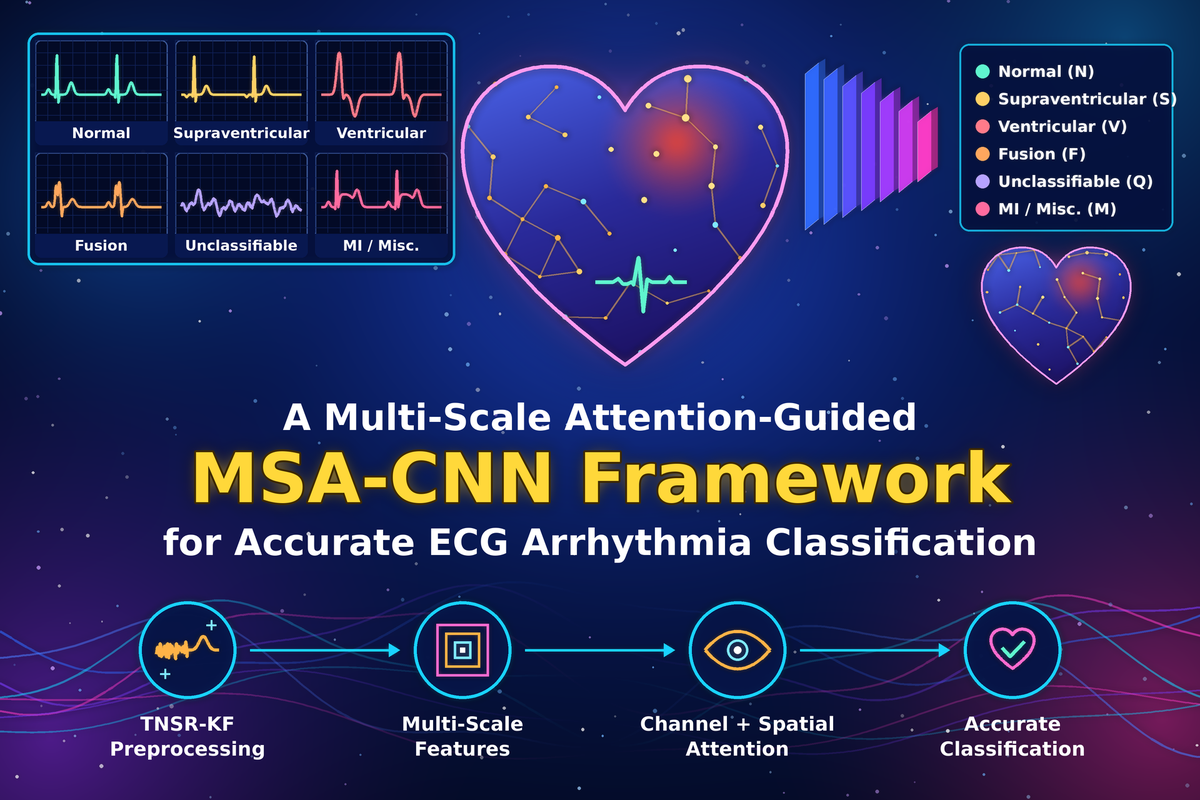
Recent breakthroughs in deep learning and advanced signal processing have transformed automated medical diagnosis. Convolutional Neural Networks (CNNs) excel at extracting spatial and temporal features from complex time-series signals like ECGs. However, raw biomedical signals often suffer from baseline wander, noise, and high dimensionality. To address these limitations, advanced state-estimation and filtering techniques—such as the Tensor Network Square Root Kalman Filter (TNSR-KF)—can be integrated to optimize feature representation and reduce noise. Building upon a refined preprocessing pipeline, a Multi-Scale Attention-Guided Convolutional Neural Network (MSA-CNN) is employed to capture multi-granular morphological patterns across various arrhythmia classes with high precision. Training convergence and model stability are monitored and validated through Accuracy vs. Epochs and Loss vs. Epochs performance curves.
To bridge the gap between theoretical machine learning models and real-world clinical deployment, this work integrates the trained workflow into an interactive, user-friendly Django web application. The end-to-end system features secure user authentication (Sign Up, Log In), an intuitive ECG image or signal upload interface, real-time class probability evaluation, comprehensive history tracking, confirmation-based deletion, and downloadable PDF reporting. This robust architecture delivers a practical tool for automated cardiac health monitoring and clinical decision support.
2. Problem Statement
Manual detection and classification of ECG arrhythmias are characterized by:
- High time consumption and susceptibility to human error
- Heavy dependency on expert cardiologist availability
- Susceptibility to noise, artifacts, and signal distortion in raw ECG recordings
- Lack of continuous training monitoring metrics (such as dynamic loss/accuracy convergence curves) during model optimization
There is a critical need for an automated, reliable end-to-end system that effectively denoises signals via advanced filtering, accurately classifies arrhythmia categories using multi-scale attention mechanisms, tracks training progression using training curves, and delivers results through an accessible web platform.
3. Input
- ECG signal and image dataset (sourced from Kaggle)
- Supported web upload formats: .jpg, .png
- Arrhythmia class categories (e.g., Normal Sinus Rhythm, Atrial Fibrillation, Premature Ventricular Contractions, etc.)
- User credentials for authentication (Sign Up / Log In)
- Real-time user input: Uploaded ECG test files via the Django web interface.
4. Output
Model training & validation evaluation artifacts:
- Accuracy vs. Epochs curve
- Loss vs. Epochs curve
- Confusion Matrix
- ROC Curve
- Performance Metrics (Accuracy, Error Rate, Precision, Recall, F1-Score, Specificity, ROC).
Saved model artifacts and web application output:
- Saved model file (.keras) and class label mapping (.json)
- Real-time classification results: Class probability distributions and Top Class (highest confidence) prediction
- Dynamic visual reporting: Ring charts, confidence bars, downloadable PDF reports, and user-specific history logs.
5. Novelty
- Integration of Tensor Network Square Root Kalman Filter (TNSR-KF) for optimal state estimation, noise reduction, and tensor-based dimensionality refinement of ECG data.
- Implementation of a Multi-Scale Attention-Guided Convolutional Neural Network (MSA-CNN) designed to focus on critical morphological wave abnormalities across different receptive fields.
- Dynamic model performance monitoring through Accuracy vs. Epochs and Loss vs. Epochs convergence plotting.
- Complete end-to-end fusion combining advanced deep learning training pipelines with a fully functional Django web application featuring user history tracking and PDF report generation.
6. Contribution
Developed a complete machine learning pipeline:
- Dataset loading, reading, exploratory visualization, and preprocessing
- TNSR-KF signal optimization layer
- MSA-CNN model training, validation, and convergence tracking (Accuracy vs. Epochs, Loss vs. Epochs)
- Performance evaluation metrics (Confusion Matrix, ROC Curve, Accuracy, Error Rate, Precision, Recall, F1-Score, Specificity, ROC)
- Model persistence (.keras and .json).
Built a feature-rich, user-friendly Django web interface incorporating:
- Secure user authentication (Sign Up, Log In, Welcome Message)
- Real-time ECG image classification and secure storage in media directories
- History management, confirmation prompts for record deletion, and downloadable PDF report generation equipped with visual confidence bars.
7. Conclusion
The proposed system successfully automates ECG arrhythmia detection and classification by synergizing Tensor Network Square Root Kalman Filtering with a Multi-Scale Attention-Guided CNN (MSA-CNN). Training stability and optimization were verified through Accuracy vs. Epochs and Loss vs. Epochs convergence plots. The model achieves high classification accuracy, validated through comprehensive confusion matrices, ROC curves, and performance metrics. Furthermore, seamless integration with a Django-based web application ensures practical, real-world utility, enabling healthcare users to upload scans, review prediction histories, manage logs, and export structured PDF reports.
8. References
[1] J. Urban et al., "Deep Learning-Based Classification and Feature Extraction Pipelines," The Lancet Digital Health, vol. 3, no. 6, pp. 1–10, 2018.
[2] G. B. Moody and R. G. Mark, "The impact of the MIT-BIH Arrhythmia Database," IEEE Engineering in Medicine and Biology Magazine, vol. 20, no. 3, pp. 45–50, 2001.
[3] K. He, X. Zhang, S. Ren, and J. Sun, "Deep Residual Learning for Image Recognition," in Proceedings of the IEEE Conference on Computer Vision and Pattern Recognition (CVPR), 2016.
[4] G. Litjens et al., "A Survey on Deep Learning in Medical Image Analysis," Medical Image Analysis, vol. 42, pp. 60–88, 2017.
Backend Programming Language
Python
Backend Web Framework
Django
Frontend Structure
HTML
Frontend Styling
CSS
No reviews available for this product.